Strikers
One of the Aelin's ranks.
A Striker is a soldier who protects Aelin and its citizens. As a rank they are a highly organised force primarily intended for warfare. The main task of Strikers is as defence of Aelin and its interests against external threats, be that land, air or sea.
The Striker suzerain is called the Warlord.
The main base for Strikers is the Barracks in Aelin City, however they have various aevy, army and navy bases across the country.
The main focus of Strikers as a rank are missions as Aelin's military, however they also take tasks from the tally system, which are jobs requested by the general populace. They must also complete a certain number of hours per month of training.

Barracks
The Barracks is situated within Southerton, has two storeys and is rectangular, with its interior being a squared figure of eight shape around two courtyards. The Barracks mainly consists of unit-related rooms, which are on the outer sides of the main corridors, but between the outer and inner unit-related rooms are more general, communal spaces, such as mess rooms and showers. Doors open both inward and outward, seemingly at random.
The unit-related rooms consist of a High office, with a Second office that leads into it, and unit-boxes. Unit-boxes are rooms dedicated to a unit and their activities. They have lockers for all unit members and act as a communal space for that particular unit; what this space is used for varies with unit preference. The Barracks is maintained by tally Strikers where possible and, if not enough volunteer for the duty, they are randomly allocated.
Vestibule
Just inside the entrance to the Barracks is a large vestibule. Visitors are met in this area and are led to the relevant office or Striker by one of the Strikers working in the vestibule, see greeters for more detail.
There are rules and regulations painted on the back wall opposite the entrance, pictorially outlining what Strikers cannot do when in the vestibule, for example it is against the rules to fight within the vestibule, this is because there is likely to be visitors from other ranks, therefore making it too dangerous.
It is illegal for non-Strikers to enter the hallways beyond the vestibule without a Striker chaperone or one of the greeters acting as an escort. Due to safety reasons it is illegal for a non-Striker to exit the vestibule into other areas of the Barracks without Striker supervision.
Tkivon
The courtyard to the left of the vestibule is a training yard with buildings on the south side and several areas devoted to different aspects of a Striker's training. This includes a secure room built by teams of Makers called the Training Bunker, which is designed to present occupants aperio generated training simulations to a specified level. For safety reasons only Strikers are permitted to enter this courtyard.
Wyaxia
The courtyard to the right of the vestibule is a gathering area that has several uses, including being a location for Striker ceremonies (such as High and Warlord swearing in), parties (such as the ryxilh events) and an execution location.
Plaques featuring ryxilh are on the walls of this courtyard, both the structural walls and some freestanding walls that have been erected for this purpose. The plaques are made of a mixture of metals, including gold, brass and silver. The ryxilhs of traitors are struck out, but the plaques are left there so that another Striker never takes the same name.
Residence Block
Suzerain
The Warlord apartment is the same as for a High and is mixed with the general population.
Striker
There are multiple Striker residence buildings in the block. Residence buildings are L-shaped and arranged in sets of four which surround a courtyard. Each residence building uses the corner of the L-shape to contain a stairwell from ground to top floor and a front desk with Makers working behind it.
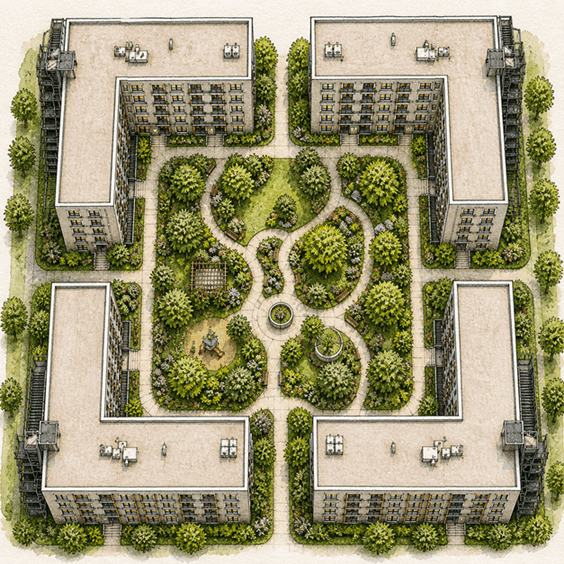
There are eleven floors, with sixteen apartments per floor in each building, with the two apartments on each end of the L-shaped buildings being for Highs. High rooms are significantly larger than normal Striker apartments.

Specialties
Strikers can have up to two specialities, based on their inclinations and attributes. The split of the specialities for an individual Striker will always equal one hundred percent, therefore if there are two then the primary speciality is the higher or the preferred of the percentages.
As an example, a Striker might be 55% virloi, 45% xrecova. In this example, the Striker would look for work denoted by VX or V primarily, but can also undertake XV work depending on the task. However if the split was more extreme, 90% kidzoi and 10% xrecova, then the Striker would not be able to undertake primarily X or XK tasks.
The percentages dictate how likely a Striker is to select or be assigned certain missions and tallies.
Strikers who have no secondary specialty and are therefore one hundred percent compatible with only one Striker speciality are colloquially referred to as being a pure speciality, or simply 'pure'.
| Primary | |||||
|---|---|---|---|---|---|
| Darxei | Kidzoi | Virloi | Xrecova | ||
| Secondary | Darxei | Pure | KD | VD | XD |
| Kidzoi | DK | Pure | VK | XK | |
| Virloi | DV | KV | Pure | XV | |
| Xrecova | DX | KX | VX | Pure | |
Darxei
Colloquially called advanceers, darxei are very talented at gathering information. They are typically the most used for diplomatic missions, as support for other ranks needing to travel, espionage and scouting.
Kidzoi
Colloquially called infanteers, kidzoi are generally used up front as a show of physical force, in the front lines of a battle. Typically known for their brute strength, they are particularly useful for breaking enemy lines, being bodyguards and leading the way for other Strikers into hostile situations.
Virloi
Colloquially called artillereers, virloi are more of a second line of offensive, they tend to form the tactics for the Strikers around them in the midst of battle. They typically have a secondary skill they rely upon as well as physical strength, for example a weapon, aerial skills, abilita or uniqua.
Xrecova
Colloquially called utiliteers, xrecova act as support to other Strikers or ranks. They are generally jack-of-all-trades who have varied skills and expertise and can therefore pick up a lot of different types of missions. They are usually trained in first aid.
Hierarchy
The Warlord is the leader of Aelin's military and all Strikers. The Reserve is a pre-selected Striker who fulfils the Warlord's responsibilities when one is not available.
Officers
Officers are High Strikers who work directly under the Warlord in the hierarchy in a specific and specialised post. They have a permanent squad that specifically supports them in their role and they and their squads do not do missions in the traditional sense. Officers include the Aeval Office, Tally Officer, Army Fortifications and Facilities Officer and Training Officer.
Units and Squads
A unit is a group of Strikers who are overseen by a High and their Second for administrative purposes. The High monitors their unit for behaviour, workload including tally counts and diligence with training.
A group of Strikers selected to perform a specific mission is called a squad. A squad is overseen by a squad leader and is disbanded once the mission is over. A squad can comprise of more than one High, however there can be only one squad leader who is chosen by the Warlord and therefore holds rank over others in the squad, High or not.
Training
Basic Training
Basic training is designed to ensure new Strikers are physically able, understand the hierarchy, procedures and processes and are capable of being called for missions and into battle if required.
The curriculum is decided by the teacher and there is a standard set of tests, including battle simulations, that the nouk-tzyk must pass in order to complete their basic training and become a fully fledged Striker. This means that the amount of time basic training lasts can vary. Zykyn basic training tends to take the longest. However, the shortest reported training period is seven years and no Striker has ever taken longer than twenty-two years. The average duration of basic training is thirteen years.
Further Training
Strikers will often train or be trained by other Strikers based on experience of certain types of warfare, weaponry or other skills. The Striker doing the teaching is known as the nouk-tryx, or Teacher, and the one doing the learning is the nouk-tihz, or Student.
In order to become a nouk-tryx, a Striker applies to the Training Office and is given explicit permission to do so. This adds them to a register of available trainers that other Strikers can use to find someone to teach them a skill.
Jwiixz
Jwiixz is the instinctive Striker capability to see and create an impression on another person. This is based on a flair possessed by all Strikers, which is why these impressions can only be seen and read by other Strikers. It is an umbrella term for the various more specific ways/reasons a Striker will leave an impression on a person.
Removing an impression from another person or leaving the process of creating one incomplete is physically and emotionally uncomfortable for the Striker doing so. The level of discomfort can vary from mild to severe pain depending on the intensity of the connection.
Tsekation
A Striker can only ever be either a tsek-farh or a tsek-fon/tsek-fel. They can be collectively referred to as tseks. Tsek-farhs are Leaders and tsek-fon and tsek-fel are Followers and Allies.
Tsek-fon have a strong connection to a tsek-farh, but tsek-fel do not. Part of that connection involves a tsek impression and a bonding activity, and the connection is forged by a specific exchange or gesture that occurs when the tsek-fon recognises a Striker as their tsek-farh due to behaviour or an action.
The gesture involves the tsek-fon mentioning the words "you and me", either alone or as part of a fuller sentence, while gently bumping their knuckles against the tsek-farh's chest. The tsek-farh will instinctively respond "always" and rest their forehead on the tsek-fon's shoulder.
Tsek-farh
A tsek-farh cannot be made a High until a tsek-fihd has come forward and announced themselves. Once this has occurred, the tsek-farh will then announce themselves to their suzerain. The announcement is an instinctive imperative prompting the Striker to inform the individual higher in the hierarchy of their new status. A tsek-farh announcing to their suzerain does not necessarily guarantee that they will become a High at that time, because that is at the suzerain's discretion.
A Striker can only remain a High if they have a tsek-fihd; if they lose their Second and do not have another potential, the tsek-farh is demoted to being a Striker again and their unit disbanded and redistributed.
Tsek-fihd
There can only be one active tsek-fihd under a tsek-farh at any given time. However, a tsek-farh might have more than one Striker who has the potential. In situations where another tsek-fon is a better fit for the tsek-farh, the active tsek-fihd will change.
In cases where a tsek-fihd is no longer a good fit, where they no longer have a strong enough connection or good suitability, they will either step down and become a tsek-fon or tsek-fel or might even detach themselves from their tsek-farh entirely.
At the point where a tsek-fon becomes suitable and appropriate to become a tsek-fihd, they will be compelled to announce that fact to their tsek-farh. Generally this will only happen if that individual is more appropriate than the active tsek-fihd or the tsek-farh does not already have one. The announcement involves a verbal statement, "You need me and I'll support you." The tsek-farh responds with, "I won't let you down" while pressing their forehead against the tsek-fihd's and holding the back of their neck.
Tsek-fon
A tsek-fon is a Striker who has strong loyalty to another Striker with tsek-farh potential and a fervent desire to follow them. A Striker finds their tsek-farh randomly; the bond is triggered when the Striker sees a tsek-farh do something characteristic that resonates with them and causes the bond to occur. The exchange that causes the bond is something that a tsek-fon is compelled to do.
The tsek impression carried by tsek-fon gives an indication of their tsek-farh's nomnature and is formed the first time they share the bonding gesture. The strong bond between the tsek-fon and their tsek-farh is cemented using this gesture, which is then repeated throughout their affiliation as a way of confirming the connection between them. It is often also used for reassurance or to convey trust.
The bond between tsek-farh and tsek-fon is unique to the Strikers involved. This connection is forged the first time they share the gesture and is renewed using a particular activity, which a tsek-farh will always instinctively know in relation to that tsek-fon.
The renewal act is particular to the tsek-fon and will usually fulfil some need they have. Renewal acts can be a variety of things, ranging from sex to sharing a meal or duelling, but the important aspect is what the tsek-fon gets out of the interaction. This could be the trust to surrender or acknowledgement for example.
Tsek-fel
A tsek-fel is a Striker who has an inclination towards a tsek-farh and a desire to follow them. There is no tsek impression or bond activity involved in the relationship between tsek-fel and their tsek-farh. The relationship is less set and more transient than with a tsek-fon; it will often either evolve into being a tsek-fon relationship or devolve as the tsek-fel loses what inclination they have and potentially go elsewhere.
Eqkuosation
The colloquial term for eqkuosation is Claiming and when an individual has been Claimed they are known as an eqkuos-rei or a Claim. A Striker can have multiple Claims at one time.
Claiming is a significant indication of a Striker in a permanent relationship. Typically a Striker would not be considered to be in an acknowledged relationship by other Strikers until the other party is Claimed. Prior to this, other Strikers would be comfortable approaching the other party without fear of reprisals.
The physical manifestation of a Claim is called an eqkuos, which refers to both the impression of the Striker and an inherent message. Sexual consummation is required to create an impression of the Striker on the other aelinuan. The process of eqkuosation involves the Striker putting their hand over the other person's heart and saying "You're mine", which triggers the sexual consummation and claiming period, which can last for anything from two to nine days. The length of time the period lasts is random from couple to couple, even with the same Striker involved. During this time the Striker will not allow their new eqkuos-rei to stray far and will continually engage in sexual contact with them.
Without the Striker having the appropriate feeling behind the attempt, it will fail. The eqkuos will fade if the Striker who it belongs to dies or if the Striker is unable to renew it over a period of around twelve months.
The message part of an eqkuos can only be read by other Strikers. The contents and intent of the message varies from Striker to Striker. For example, some are incredibly vicious warnings for others to stay away from an eqkuos-rei, while others encourage protection and are not necessarily threatening. These messages are far more intense in the beginning, especially in the week following consummation and in the day or so following renewal.
An eqkuos without renewal lasts around a year. If an eqkuos fades and is established again, it is referred to as a reeqkuosation.
When a Striker eqkuosates their lover, if a zika previously existed it will automatically be upgraded. The zika is no longer visible.
Vlik-rei
Following the death of a Striker, their eqkuos-rei's eqkuos will fade and they will become known as that Striker's vlik-rei instead. Other Strikers who knew the dead individual will often take it upon themselves to watch over their vlik-rei for some time afterwards.
Ekrosation
When a Striker desires the eqkuos-rei of another Striker they are able to create an ekros during sexual contact with that eqkuos-rei as a way of officially countering the existing Claim. The individual then becomes known as that Striker's ekros-jen.
The ekrosation process involves covering the existing eqkuos on an aelinuan with their own, as a challenge to the Striker with the original Claim. The original Striker will then respond by calling for nilx-zrav to determine whose eqkuos will remain.
The battle terms are decided by the original Striker. The loser of the nilx-zrav has to remove their eqkuos from the Claim. The loser must stay away from the Claimed aelinuan while the winner's eqkuos is in place, regardless of the Claim's wishes.
If the challenger is defeated or they win and are rejected by the Claim and their equkos fades, that Striker can never declare ekros-jen on that person again.
Yiivation
Yiivation is what happens when two Strikers want to become lovers. The indication of yiiv-koa is the impression of the other Striker in the relationship, without any particular emotion or message conveyed along with it. It is a simple declaration of their nomnature.
The process of two Strikers becoming yiiv-lea involves one of the Strikers putting a hand over the other's heart and saying, "Say you're mine." The second Striker then responds by putting their hand over the first Striker's hand and replies, "I'm yours. And you belong to me." To which the first Striker finishes by saying, "I belong to you." Before the response is given by the second Striker there is often a physically intense moment, where base Striker instincts come into play.
Sexual consummation is required to create an impression of each Striker on the other. The yiivation period following this can last for anything from two to nine days. The length of time the period lasts is random from yiiv-lea to yiiv-lea. During this time the Strikers will not stray far and will continually engage in sexual contact with them.
A yiiv can be renewed at any time, for example if the bond feels threatened in some way or one of the Strikers involved needs the confirmation. An individual with a yiiv is also able to increase or decrease the intensity of that yiiv, making it more or less noticeable as needed.
Zikation
A zika-syo, otherwise known as a Trust, is a non-Striker under the protection of a Striker. Establishing a Trust is a process much like yiivation or eqkuosation; the Striker creates an impression on another person that indicates their association and protection, which is perceived by other Strikers as the owner's nomnature.
The physical manifestation of a zika-syo is called the zika. A zika is simpler and not as potent as a yiiv or an eqkuos, however it lasts until removed, twelve months or so pass without renewal, or the Striker bestowing it dies. It can be renewed at any time.
The process of creating a zika involves making physical contact with the non-Striker, most often putting a hand on their shoulder, and saying, "You're a good friend".
A zika is the only jwiixz that is not compelled. Strikers make a decision and do it consciously to protect individuals, but it is more for cultural reasons than instinct or a biological/psychological imperative.
Nouk
When Strikers learn something officially it is known as nouk and the teacher during any training is a nouk-tryx. If the student is doing basic training they are known as a nouk-tzyk, otherwise the student is a nouk-tihz.
Nilx
A Striker duel is known as a nilx and there are three official types of duel that they can challenge another Striker to. A nilx-zrav is the most serious and is used to settle disputes, most notably in relation to ekrosation. A nilx-klah is a casual duel for fun or for training purposes. Finally, a nilx-sihn is a special duel that allows for conditions such as only fighting with weapons or only with magic.
Prykiv
Known colloquially as the Striker Four, prykiv refers to the four aspects of life that help reinforce and condition a Striker. Each Striker has a differing focus on these aspects and that is where reference to their prykiv order comes from; the common phrase being, "Sex, Sleep, Food, Fight. Not necessarily in that order."
The four aspects are:
- Fight - their job, their means of forgiveness and their reason for being
- Food - Strikers tend to eat a lot due to the aelinuan body's ability to run on food as well as aeryn; getting the body used to consuming large amounts of food means that in an emergency situation their body could make use of food when it runs out of aeryn to readily use and keep them going
- Sex - a key part of the Striker community and helps to drive Strikers to be social outside their rank
- Sleep - vecrucia recovery
Ryxilh
When a Striker reaches a certain level of notoriety amongst their rank, a particular name might surface and be used by other Strikers. When that name is recognised by the Warlord and put onto a plaque in Wyaxia it becomes a ryxilh. The name is usually related to the Striker's personality or capabilities in some way. This is done during an event in Wyaxia known, quite simply, as the Legend ceremony or the ryxilh ceremony.
Highs are very likely to have a ryxilh, however contrary to common belief amongst Strikers it is not necessary.
Due to the presence of the tsek bond, a ryxilhless tsek-fon will typically be known and referred to by their tsek-farh's ryxilh. Tsek-farh ryxilh will always be broader reaching and able to be interpreted in multiple ways for this reason.
By-laws
The by-laws exist to regulate Striker behaviour in a more specific manner than the APRLS, often dealing with concepts that only Strikers can relate to or understand. The by-laws are detailed in an illustrated book with strong phallic imagery. The by-laws and associated book are updated infrequently and not often referenced, however they are still in use and circulation.
Forgiveness
The period before a Striker forgives a transgression can last a variable amount of time depending upon the severity of the transgression and how deeply the Striker is affected by it. The violated Striker will not interact with the malefactor until they ultimately decide to forgive them.
The act of forgiveness involves physical confrontation, to which the perpetrator cannot respond. The confrontation will last until the wronged party is satisfied and following that moment the transgression is considered forgiven. The confrontation can vary from a punch in the arm to a severe beating after which the forgiven Striker is provided medical aid.