Aetris
Learn about the mother trees who birth aelinuans.
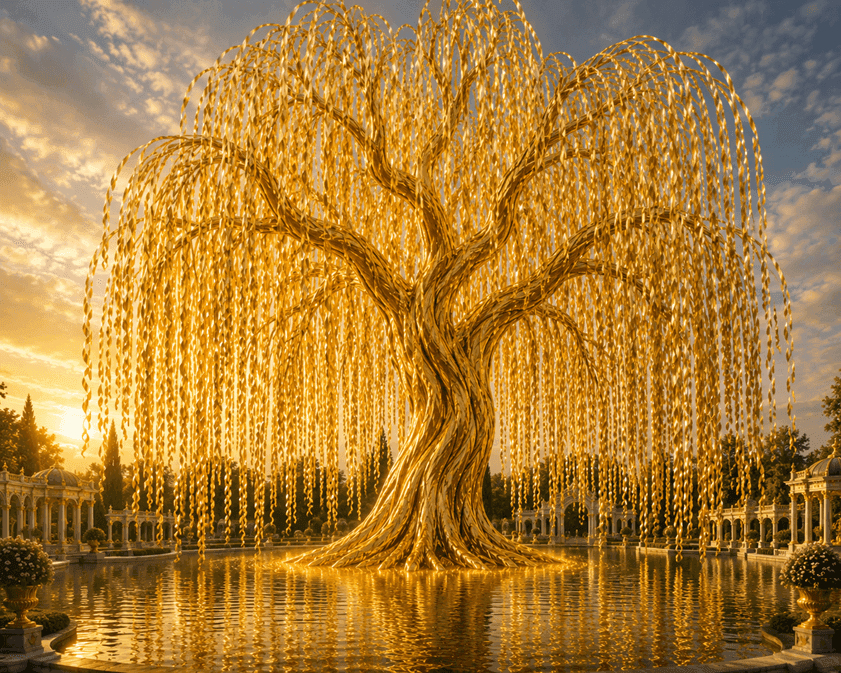
The golden trees from which aelinuans are born are called aetri. Aetri are responsible for the entirety of an aelinuan's life cycle; aelinuans are born from an aetri, aetris provide the aeyra required for them to breathe and when aelinuans die they fade and return to their aetri as an appendage on the aetri called a ribbon.
Aetri sap is golden and used for bonding ceremonies and their golden bark causes the nullification of externally affecting abilita and uniqua.
Originally only one aetri existed, Aeternia, however saplings were created from Aeternia and taken to distant places across Ephillion to be planted. These aetri are known as Aeternia's daughters.
Ribbons
The aetri appendage colloquially known as a ribbon is actually the physical manifestation of a lingering wisp of a soul. They do resemble a pale gold ribbon once they have bloomed, however they begin as a bud. Ribbons disappear from the aetri branches when no one alive remembers the individual the soul remnant belonged to.
Aeternia
Aeternia is the original mother aetri brought to Ephillion from Earth during the first colonisation and founding of Aelin. The area in which Aeternia resides in the centre of Aelin City is known as Aeternia's Glade.
Daughters
Shortly after the founding of Aelin, five saplings were created by Aeternia. The Oracle of the time harvested the saplings and arranged for them to be taken and planted in distant places across Ephillion. One of the saplings, which was planted in Tetakon, died but the others survive to this day in the following locations:
- Gyvifrax, Pedlwers - Aeylrena
- Laudbyz, Doluround - Aevinra
- Beytknippii, Tolpeic - Aebraya
- Espattino, Kophiekon - Aecasa
- Jyuuce, Schmuu - Aeseilia
These trees are generally referred to either by name or based on their location, e.g. the Doluround aetri. They are also colloquially referred to as Aeternia's daughters.
Reproduction
Velures
A velure is an aelinuan who has been ritually cleansed in the golden waters of an aetri and as a result activates the velurea flair. A velure is responsible for a key part of the aelinuan reproductive cycle; they hear the Lament, a song that an aetri produces in order to communicate, and are sent by that aetri to Earth in order to cultivate and eventually retrieve a human soul.
The process of an aelinuan becoming a velure requires them to have the velurea flair prior to being immersed in the aetri's water. This process is ritualised in some cultures, for example it is a rite of passage for Celestials in Aelin called the Vaeliadis Ceremony.
Following the activation of the flair, velures are then committed to performing velurea for a certain period before being essentially retired via a process known as an alteveck axis.
Velurea
The first stage of velurea happens before the velure is involved; individuals must go to Earth and create aevoicas, replicas of human souls that appear as a glowing golden orb which are carried in vieré, to present to an aetri. In Aelin the individuals who bring back the soul copies are known as Aevoica Reapers. Once the aetri receives the aevoica, it will determine the soul's viability for rebirth and either dispose of or absorb it.
Once a velure begins to hear the Lament it triggers the purge, which lasts for three days, to prepare their body for a prolonged period sequestering on Earth. They then go to the aetri whose Lament is calling them to receive the aevoica, the replica of their aevouré's soul, which rises out of the aetri's water and is absorbed into their body. This act causes the velure to go into syspa.
The velure then travels to Earth via the nearest portal and uses the soul replica in conjunction with the Lure to locate their aevouré. Each soul emits a unique resonance, which allows the velure to fix onto the human soul's location with the Lure.
During velurea on Earth, velures go into a sequestered state in which their body becomes incorporeal due to a lack of readily available aeyra. After sequestering they find their aevouré and then follow them, nisharring the soul to prepare it until the human dies.
Once the aevouré is dead the velure tears the soul from their human body. This is done by touching the soul, as this touch stops a soul from passing. However, there are several obstacles to overcome. If the soul is not taken quickly enough it will dissipate into the body, so the velure must act within a very short window of opportunity. Trying to extract the soul too early will also damage the soul irreparably.
When the soul has been extracted the velure uses the Lure to lead it back to their aetri. Once the velure has returned to the aetri, they release the human soul into her waters to be absorbed.
The Lament
Also known by a name relating to the birth aetri of an individual, e.g. 'Aeternia's Lament'.
The Lament is a song produced by aetri that only aelinuans with the active velurea flair can hear. A thread of song exists for each aevouré that aetris hold ready for a velure to take and there are always more songs than there are velures to heed them.
If a song is not responded to by a velure within the time it is viable (the time an aevouré can be given a velure in enough time for soul collection to occur) the aetri aborts the aevouré and that particular thread of song stops.
Velures hear threads of the Lament depending upon the velurea lengths they are able to accept; a velure who is able to take aevourés for around seven years will hear songs for aevourés lasting around this period of time. The amount of time a velure can endure velurea depends upon the stability of their mind, the safe period of time they can remain in syspa without the risk of death, and the amount of aeryn they are able to store for the nisharre.
The lifetime of an aevouré affects the sounds of the song; the longer the velurea will last, the deeper the song sounds. As the soul deteriorates and the lifetime grows shorter, the pitch of its song will become higher.
All velures naturally have the capability to hear the Lament. If someone with the velurea flair is bathed in the golden waters of an aetri, within a period of up to about a year, they will begin to hear the Lament.
Some velures hear the Lament constantly, at a level they cannot ignore but that, over time, they can grow used to and these shorter-lived velures tend to hear the Lament at an increasing volume until the end of their lives.
Experiencing the alteveck axis is what causes a velure to lose the ability to hear the Lament.
Syspa
Syspa is the flair which allows aelinuans to achieve a state while on velurea where they are essentially just a soul connected to their compacted aeryn. This uses embodia at a very slow rate.
An aelinuan in syspa has no sense of self and works entirely on instinct, as while in syspa they are not truly registering anything they see or hear. This means that when they return to Ephillion following velurea they do so with a factual memory of the time spent in syspa, but have no thoughts to put against them.
Velures first achieve syspa during their first velurea; the absorption of the soul replica is what kick-starts the flair.
It is possible to break a aelinuan out of syspa, however it is quite difficult and usually requires physical force.
Sequestering
During velurea, aelinuans must sequester; deconstructing their physical form in order to preserve as much aeryn as possible due to the lack of available aeyra on Earth. Sequestered aelinuans will not be visible to most humans and are intangible.
The efficiency in which a velure's body uses aeryn during sequestering is why velures have different velurea periods.
Nisharre
Nisharre is the process by which a velure prepares a human soul for collection. While a velure is performing velurea they stay very close to the human in order to saturate the soul with aeydl, which makes the soul collection process more likely to succeed. This process also slowly kills the aevouré, with the longer nisharre is performed upon a soul, the greater chance there is of a successful collection. This means that a longer velurea has a higher likelihood of success. A soul that has experienced nisharre for less than a month has an infinitesimal chance of being viable for collection.
Velure Success Rate
There is a low rate of success for the soul collection process, as on average only 12% of velurea result in a soul being reborn as an aelinuan. 76% of soul collections fail, usually because the velure misses the short window of opportunity, the soul resists the Lure too strongly and breaks or the velure hasn't nisharred for long or well enough.
Of the soul collection successes that are absorbed by an aetri, a further 50% are aborted before they are reborn, usually because the soul is corrupt in a way the aetri does not accept or the soul itself rejects the process.
Vivaera
This is the rest period velures take following velurea, which is both to recuperate their body and mind, but also to properly process the time that they have spent in syspa.
In syspa the velure can react to everything they have seen and set it aside. When they have woken, the memories of the velurea will seem far off and older than they are. They do not have any direct personal connection to these memories.
The amount of time vivaera lasts also roughly corresponds with the velure's years in terms of days, for example a six year velure would experience six days of vivaera.
Alteveck Axis
This is a life altering event in which a velure loses their ability to hear the Lament. The longer a velure's nisharre lasts, the longer they tend to continue velurea before they reach the minimum age threshold and their axis is able to occur. A velure is instinctively aware of their alteveck axis, they know the moment it has occurred and where relevant what caused it.
The amount of time a velure can continue with velurea is limited and varies depending upon their nisharre duration period. There is a minimum age threshold for axis viability and the vast majority of axes occur naturally within the typical period. These are considered the velure essentially aging out of being able to perform velurea.
However, an axis can be catalysed by an external stimulus and therefore can fall slightly outside of the usual age range for the average axis. They are often caused by significant life events such as the death of a loved one.
The earliest axis on record was at one thousand, one hundred and sixteen years old.